Answers that explain
Not "the number changes", but "the number increases by 1 to the right and decreases by 1 downwards". After every answer you see exactly which rules applied, and an example of the one you missed.
For iPhone · English and Swedish
Matrix tasks of the kind used in recruitment logic tests, with answers that explain exactly what you missed.
Five tasks free. One-time purchase, no subscription.
The format settles in after a few days. What makes the difference is understanding every miss.
Not "the number changes", but "the number increases by 1 to the right and decreases by 1 downwards". After every answer you see exactly which rules applied, and an example of the one you missed.
Twelve timed tasks with adaptive difficulty, just like in recruitment. Afterwards a level 1–10, your score and a review of every task.
Every task is generated on the phone and checked so that exactly one option is correct. Fourteen rule types, ten levels, no list to run out of.
Calm, almost monochrome. The task is the only thing that takes attention.
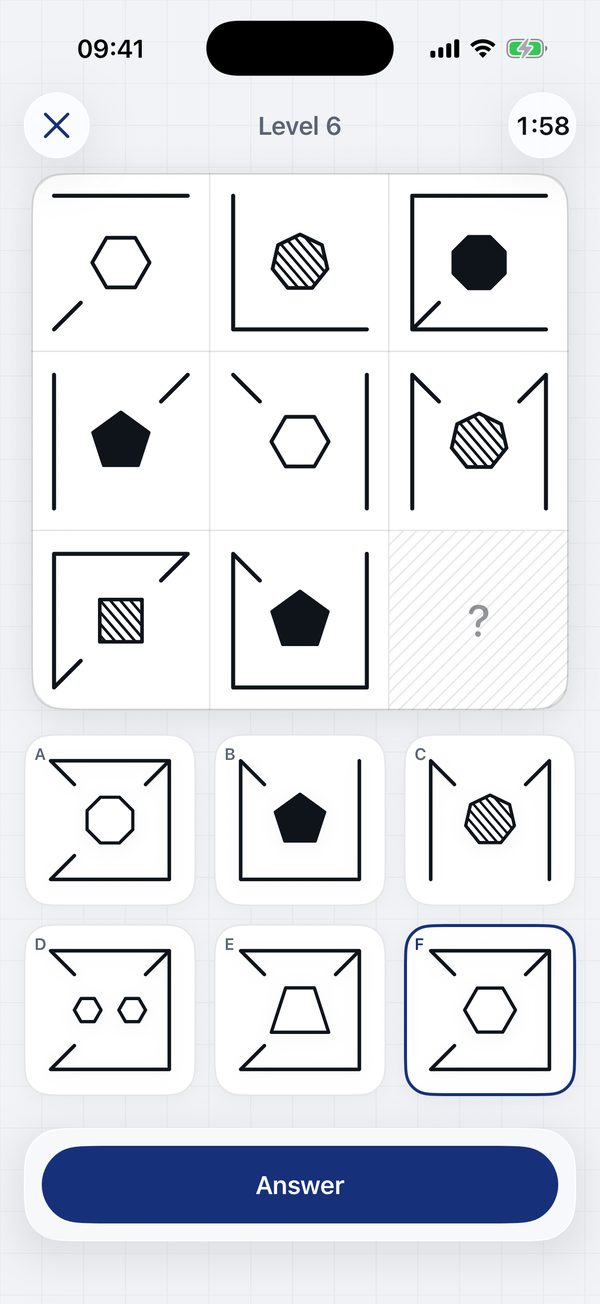
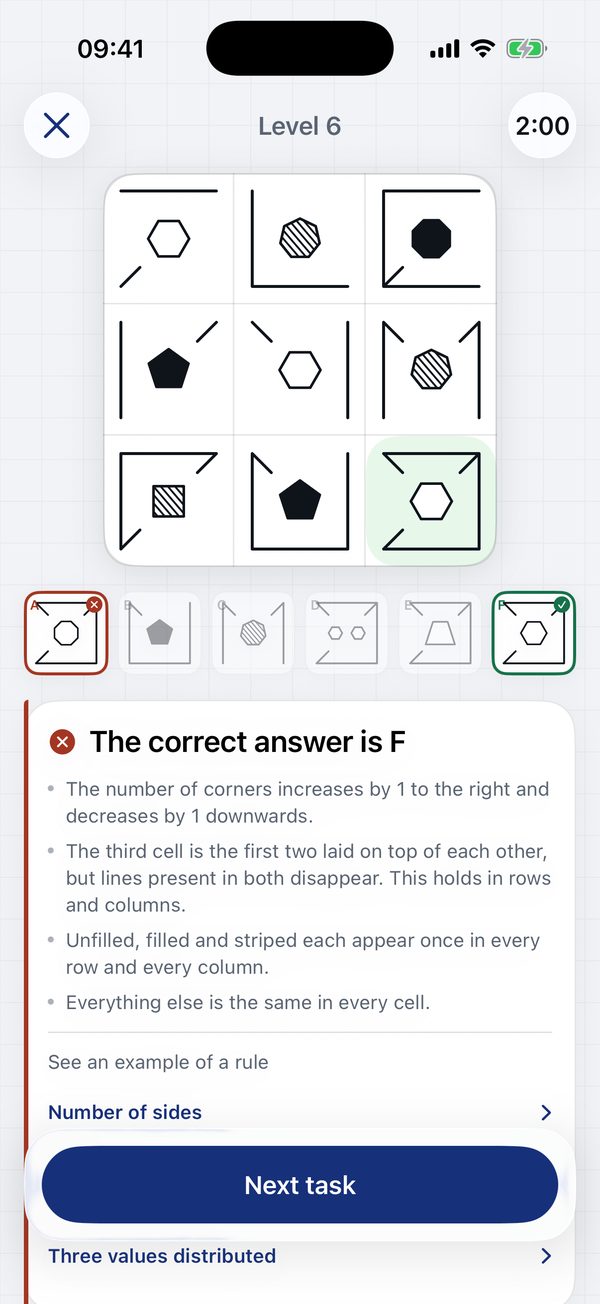
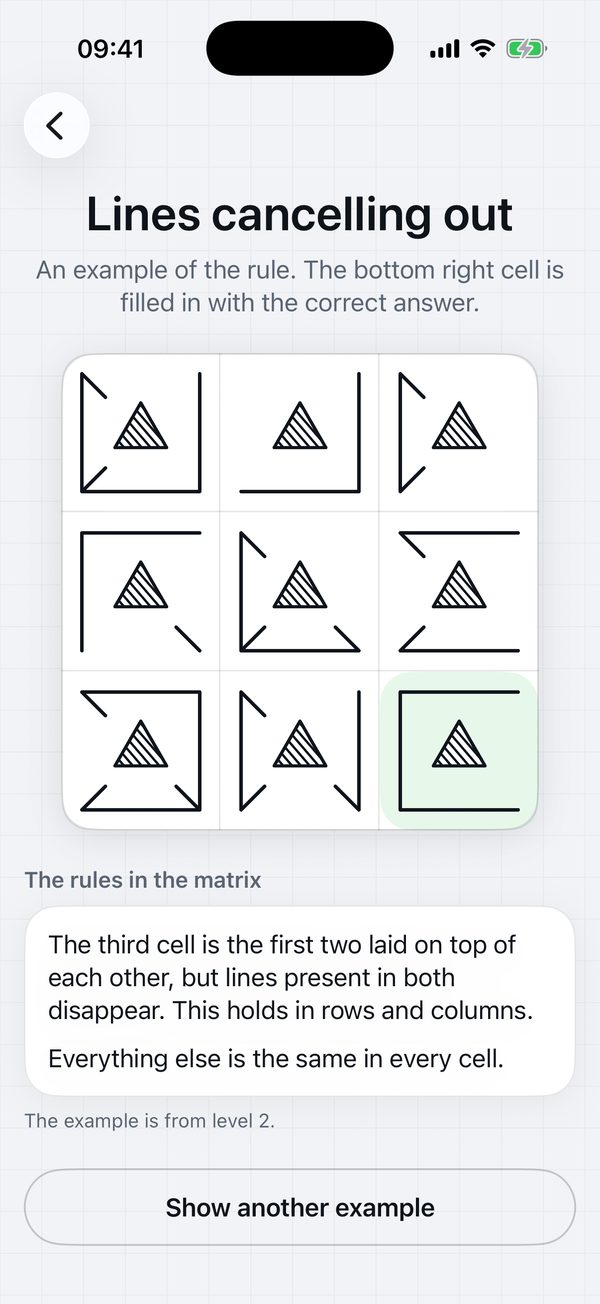
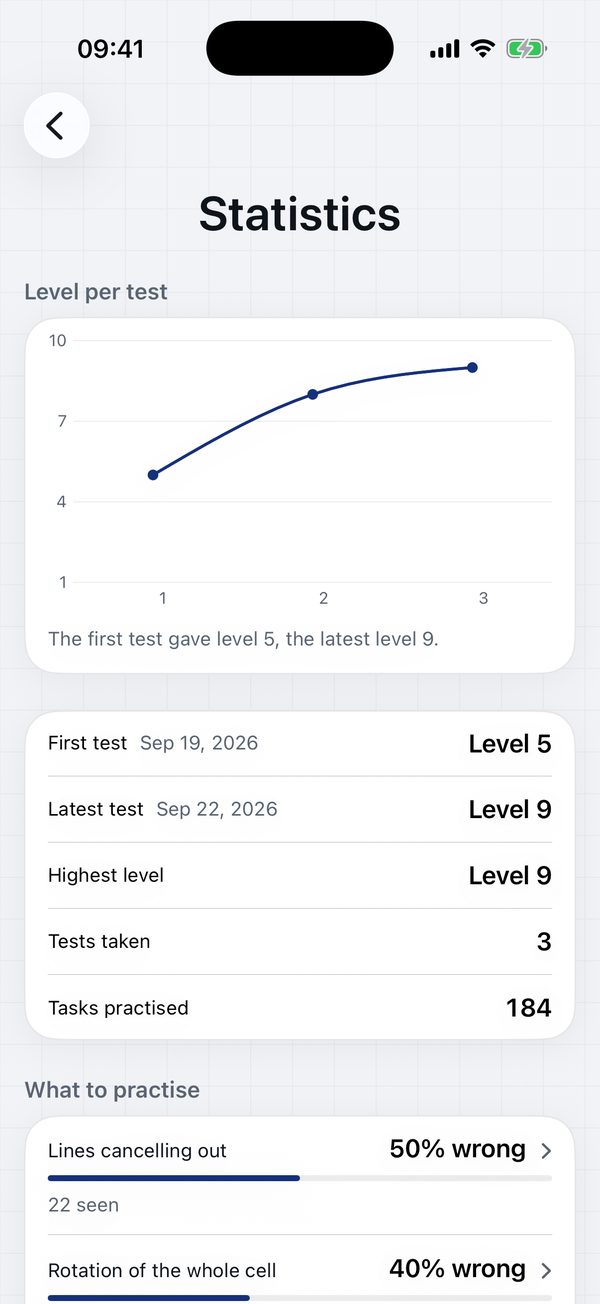
Twenty tasks in rising difficulty, right here. The same answers the app gives.
Loading the tasks …
Before the test
The Alva Labs logic test is one of the most common in Swedish recruitment and is used internationally. It is built on matrix tasks of this kind, with rising difficulty. Candidates often have only a few days between the invitation and the test.
Matrix Reasoning Trainer practises exactly that format, with answers in practice mode and a clock in test mode.
Matrix Reasoning Trainer is independent and has no connection to Alva Labs. The tasks are our own, and the level in the app is the app's own scale, not a prediction of the result on any other test.
Five practice tasks with answers are free. The rest is unlocked with a one-time purchase, no subscription. No login, no ads. Your results stay on the phone.
Get it on the App StoreRequires an iPhone with iOS 17 or later.
What the format is, how to approach a task, and answers to what people usually ask.
A matrix reasoning test, often called a logic test, abstract reasoning test or aptitude test, measures the ability to see patterns in figures. Each task is a grid of three by three cells. Eight of them contain figures that follow one or more rules, and the ninth is missing. The task is to find the rules and choose the option that fits the empty cell.
The rules hold in both rows and columns and govern different parts of the figure: shape, number, size, fill, direction, lines at the edge or a dot that moves. The easiest tasks have one rule. The hardest have three or four at once, and the options differ in one detail only.
The format is common in recruitment, as part of the screening before interviews, and it can be practised. Someone who has seen the format before loses no time working out the task and goes in calmer.
The format settles in after a few days. What matters is having seen every rule type and having done a few tasks against the clock. A few focused sessions give more than weeks of scattered practice.
Practice makes a difference on this type of task. Someone who knows the format does not have to learn it during the test, makes fewer careless mistakes and uses the time better. Nobody can promise a result, and the level in the app is the app's own scale.
The words are used interchangeably. Aptitude test is the broad term for tests that measure thinking. Logic test is the part about patterns and inference. Matrix test is the format: a grid of three by three figures with one cell missing.
The app has fourteen rule types: step by step change, three values distributed, constant, lines combined, lines cancelling out, arithmetic on the number, movement along a path, mirroring, rotation of the whole cell, nested figures, number of sides, degree of fill, conditional rule and covariation. The answer tells you which ones applied in each task.
Five practice tasks are free. The rest is unlocked with a one-time purchase, no subscription. The price is shown in the App Store.
Results and statistics stay on the phone. The app has no accounts and no ads. It sends anonymous usage statistics, which you can turn off. This website uses no cookies and no tracking. See the privacy policy.